Hometown Post
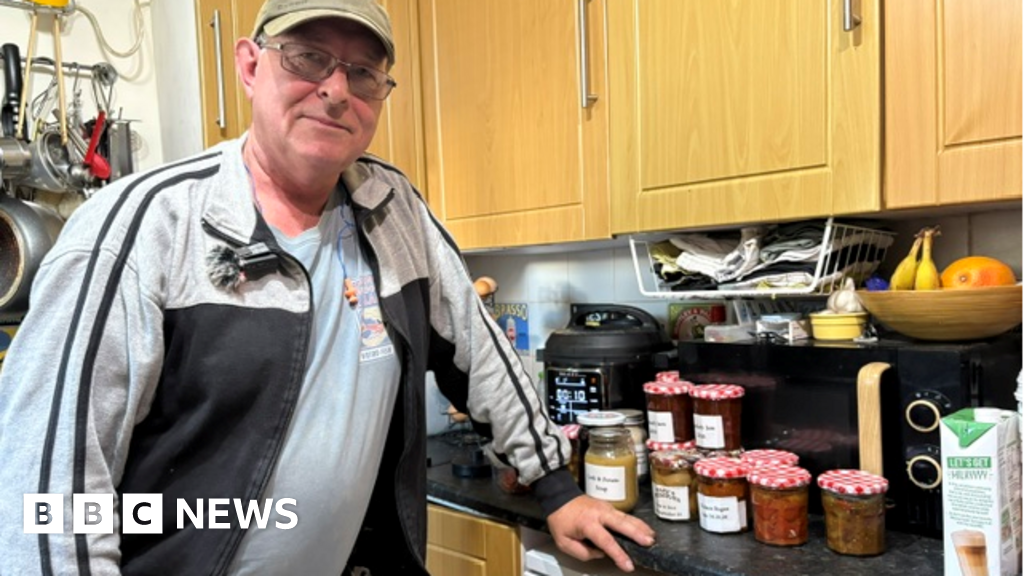
26 minutes ago Esme Ashcroft Political reporter for Gloucestershire BBC Shane has been prepping for more than 20 years Advice was issued by the government last week in a bid to encourage us all to stock up on supplies in case of a national emergency. One man who needs no telling to prepare is forager and gardener Shane whose terraced house on a quiet Forest of Dean street looks like any other. But behind his front door there are hundreds of jars, bottles and packets of food stacked high and hidden in every room.
"I've got enough food to last for 12 months definitely, with what we grow in the garden, all of our solar [power] and the springs, we should do all right," says Shane, who declined to give his surname. Shane is what is known as a prepper - someone who has stocks of food, water and non-mains energy sources - in case of a catastrophic disaster. He has been prepping for more than 20 years, predominantly to cope with power outages and road closures which affect rural areas of the Forest of Dean at times of extreme weather but more recently because of global tensions.
Recently, however, Shane has noticed an increase in people asking him about prepping, especially those concerned with the rising frequency of extreme weather events and the threat of cyber attacks on critical networks such as food supply chains. More from Gloucestershire "It seems to be now there are threats from AI, cyber attacks, there's crop failures, there's supermarket prices shooting up, there's even a threat from Russia and China - so they all seem to be coming to a head now," he says. "A lot of people are getting quite frightened about it so it's a good time, I think, just to get yourself ready." Shane's main consideration while prepping is storage.
He uses a chest in his living room to store shop-bought products such as honey and custard. It is metal to prevent mice getting in. He has filing cabinets filled with jars of preserves which he self-cans and areas dedicated to dehydrated goods such as chillies, which he says will last for years.
Spaces behind doors and sofas is given over to keeping various camping stoves, solar-powered lights and batteries. He also has a gravity shower which will enable him to wash if the mains water is off as well as a wood-burner to warm up a kettle of water. Shane says he tries to find tasty options when he preserves food Shane's cupboards and drawers are stuffed to bursting with all sorts of tempting and unusual foods, including leek and potato soup and chicken Rogan Josh curries.
In fact Shane is confident he can preserve almost anything - with the exception of dairy which he says would curdle. "A lot of people say about storing rice and beans but if you're feeling miserable anyway, why do you want to store rice and beans? "You can buy puddings and fruit in tins, cereal bars keep for a long time - just get something you can enjoy rather than the bare, basic, gritty stuff," he says.
Shane, who has written a number of books about specialist fruit and vegetables, says he operates a strict system when it comes to food with expiry dates. "You always try to sort of rotate and keep an eye on the dates," he says. "Some things will keep longer - chutneys will keep for two or three years, pickles maybe a year, meat and fish a year as well.
"And if you've got to use them, replace them, so you've always got that same amount in store all the time." And while it may seem like a lot of effort, he says that "after a while it just becomes second nature". 'Be ready checklist' The concept of prepping is not new. During the Cold War the UK government ran a series of Protect and Survive campaigns which encouraged households to keep supplies in a special 'fall out room'. And official food reserves were kept in 60 secret locations across the country until the mid-90s.
In Europe many places still advise the public to keep up to 10 days of supplies in case of emergencies. While there is no immediate widescale public threat, the government last week launched a "national resilience conversation". This includes a 'be ready checklist' which states households should have an emergency kit containing enough food, water and medication to last for three days as well as cash, a battery and a wind-up radio.
The Cabinet Office said the campaign would build over the next three years. Chloe Turner is keen for the county to work on its emergency food security strategy Councillors in Gloucestershire are also calling for more to be done to increase emergency food and energy resilience at a local level. Stroud District Council leader and county councillor Chloe Turner has asked for more thought to be put into a local plan for the county.
"We need to be thinking about a system change and what local authorities and what government can do to support people if there is a crisis," she says. "That might be a crisis of getting food in to the country but it might also be a crisis about how we distribute food and how we store food and how we actually get it to people." For Shane, his prepping will continue in earnest and, while he is more than happy to offer advice, he is not looking for any new housemates. "So many people say to me, 'if things go wrong, I'm coming to live with you'," he says.
"But it's only a little house and there's only so many people we can fit in." More on this story
Source: BBC