Hometown Post
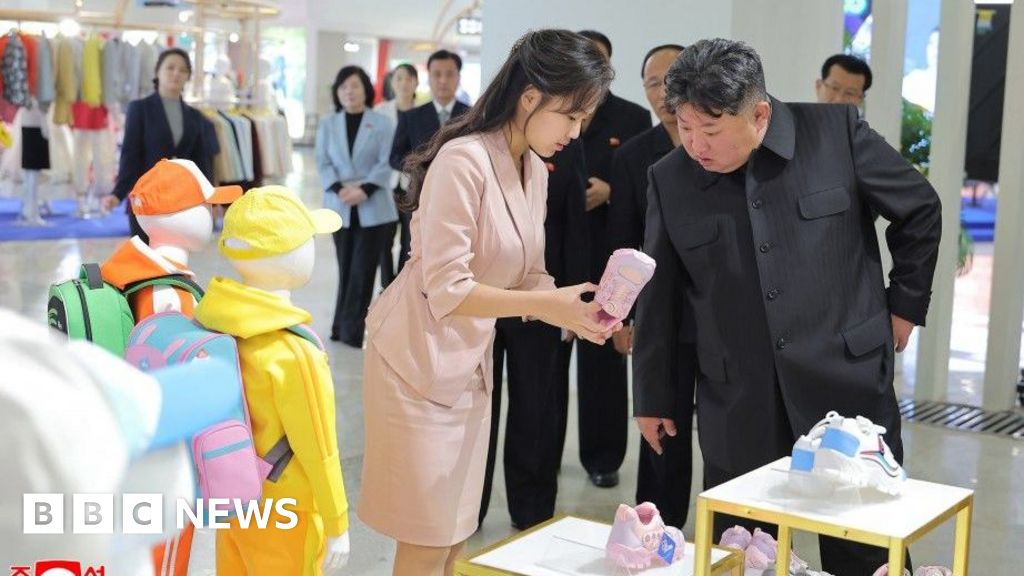
North Korea publishes photos of Kim Jong Un - why do rumours of his death keep coming back? 54 minutes ago Laura Bicker China correspondent KCNA North Korean state media released photos of Kim Jong Un shortly after rumours of his death started spreading online Kim Jong Un has appeared in North Korean state media looking remarkably healthy for a man rumoured to have died from a brain haemorrhage. Photographs published by state newspaper Rodong Sinmun show the 42-year-old dictator touring what the paper said was a clothing and footwear exhibition with his daughter. The images emerged hours after a Chinese dissident who lives in the US claimed, without evidence, that Kim had been taken to a hospital in Beijing in a coma and had died.
For those who watch North Korea closely, this kind of rumour has become almost routine. In one of the world's most secretive states, facts are often difficult to verify, creating fertile ground for speculation. This latest claim originated with Wanjun Xie, who identifies himself as chairman of the Chinese Democratic Party, a group banned by Chinese authorities.
He has previously circulated unverified claims, including speculation about the death of Chinese leader Xi Jinping. Xie alleged that Kim suffered a severe brain haemorrhage and was transferred to Beijing because North Korea lacked the medical facilities to treat him. He claimed Kim later died and that his body had been secretly returned to North Korea, with the regime concealing his death.
Yet the photographs tell a different story. Kim is seen examining displays, accompanied by Kim Ju Ae and his usual entourage of officials. While there is no way to know exactly when the images were taken, there are other reasons to doubt the claim.
There would probably be signs beyond North Korea's borders if there were a sudden collapse in Kim's health. China could tighten security along its frontier to prepare for potential instability or refugee flows. Activity around North Korean diplomatic missions might also increase.
Defectors in South Korea often receive information through informal networks along the Chinese border. None of this has happened. South Korean intelligence officials, meanwhile, told Yonhap they had heard nothing to support the reports.
The rumour also echoes previous false alarms. In 2020, a high-profile North Korean defector claimed he was "99% certain" Kim had died following cardiovascular surgery. Not long afterwards, Kim appeared in public and the claim unravelled.
So why do these rumours keep resurfacing? The first reason is succession. North Korea has been ruled by the Kim family for three generations, but what happens after Kim Jong Un remains less certain than it was for his predecessors.
Kim Il Sung spent decades preparing his son, Kim Jong Il, for power. By the time Kim Il Sung died in 1994, the succession plan was firmly established. Kim Jong Il's transition was relatively smooth.
Kim Jong Un's rise was faster and more precarious. After Kim Jong Il suffered a stroke in 2008, his youngest son was rapidly promoted through the ranks. By the time his father died in 2011, he had been publicly identified as the future leader.
Even so, Kim Jong Un spent years consolidating power, purging rivals and eliminating perceived threats. Today, South Korea's intelligence agency believes he may be preparing his daughter as a successor. She has increasingly appeared at high-profile events and military displays.
But she is thought to be only 13 years old. North Korea has never been led by a woman, and she has not been formally designated as heir. Her youth would also leave her vulnerable in any power struggle.
All of this uncertainty helps explain why rumours about Kim's health attract so much attention. KCNA South Korean intelligence believes Kim may be preparing his daughter as a successor The second reason is that the rumours are not entirely implausible. Kim is overweight and a heavy smoker.
South Korea's National Intelligence Service has repeatedly warned that his lifestyle puts him at higher risk of cardiovascular disease. Heart problems and strokes also run in the Kim family. If anything were to happen to Kim, the stakes are high for neighbouring countries and the wider international community.
Any sudden leadership crisis raises difficult questions about control of North Korea's nuclear weapons and the prospect of political instability. Would a power struggle tempt hardliners to act aggressively? Could unrest trigger a refugee crisis along the Chinese border?
These are questions that concern not only Beijing and Seoul but also Washington, which maintains around 28,000 troops in South Korea. Intelligence agencies watch Kim Jong Un closely so they are prepared for any news. Because North Korea remains an information black hole, it is also an easy target for false reports.
Only a tiny circle has regular access to its leader. Even intelligence agencies struggle to obtain reliable information, and much of what emerges is heavily caveated as unverified or highly likely rather than confirmed fact. The regime itself is also suspected of deliberately encouraging confusion, leaking misleading information to obscure what is really happening inside the country.
So it is hard to believe that Wanjun Xie had somehow stumbled across such significant news, when it had eluded those whose job it is to stay across it. He may simply have been seeking attention. Or he may have wanted to embarrass Beijing by highlighting its ties to Pyongyang, although those are well-established for the world to see.
Whatever his motive, Xie is far from the first person to exploit the uncertainty surrounding North Korea's leadership.
Source: BBC